Wednesday, February 23, 2011

The Louisiana Coast: Oil spills and more

By Larissa Graham, Long Island Sound Study Educator, New York Sea Grant

While in graduate school, NYSG's Long Island Sound Educator, Larissa Graham, traveled down to New Orleans to help rebuild the many neighborhoods that were damaged from Hurricane Katrina. Now, five years later, she’ll be returning to the Gulf coast; "This time we’ll be focusing on habitats, the home to wildlife and lifeline for much of New Orleans’ economy" she says. Graham provides a bit of background for those that are not familiar with the Louisianan coast in a recent post:

On April 20, 2010, the Deepwater Horizon drilling platform exploded, flooding the surrounding waters with crude oil. An estimated 4.9 million barrels of oil were estimated to have flowed into the Gulf before it was completely sealed this past September. During the cleanup process, 6.8 million liters of dispersant (think: soap-like substance) were used at depth and surface levels to break up the oil. The Deepwater Horizon incident was the largest oil spill to date—in the world.


Oil spill, from the sky.

After watching the news coverage, many individuals thought that drilling in the Gulf of Mexico should be stopped. But, that could also have a negative effect on the Gulf coast states’ economies. Did you know that ¼ of all of the US’s crude oil comes from the Gulf? And, Louisiana relies on oil for more than just the day-to-day luxuries of life. One out of every 13 Louisianans work on the drilling and production platforms off the coast. So, without the drilling off the Gulf a lot of people would be out of a job. We’d think that people in the two other major industries in Louisiana—fisheries and tourism--would be against drilling but, they’re not. Chances are someone in their family works in the oil drilling industry which makes the oil industry part of everyone’s livelihood (more on that later…).

Looking at the coast of Louisiana, you can see the effects of the drilling. Offshore is peppered with over 3500 production platforms (platforms that are pumping oil) and even more drilling platforms. Between those that are inactive and those that are supplying oil, there are an estimated 40 THOUSAND OIL WELLS in Gulf waters. And, to add to that, imagine all of the pipelines that snake underwater to transport oil to the shore.


ACTIVE oil wells off the Gulf coast.

At first, oil wells were drilled in shallow water (1,000 feet) but, since 1994, current technology has taken the drilling industry further offshore and now the machines can reach depths of 10,000 feet! Unfortunately, our technology for safety and preparedness has not come as far. The Deepwater Horizon well was at a mere 5,000 feet and think about the tragedy that surrounded and the trouble experts had capping that oil well.

As horrible as it was, the oil spill wasn’t the first problem that New Orleans has faced. We all know about Katrina—a devastating hurricane that filled New Orleans up like a bowl, leaving about 50% of households under 4 feet of polluted water. Now the Army Corps is building a 350-mile ring of levees around New Orleans that were designed to protect the City from 100-year flood levels. Will these walls be able to protect this City that was built below sea level? Only time will tell…

Besides the occasional hurricane, New Orleans has a tremendous rate of wetland loss. For those that don’t know, wetlands are extremely important as they serve as feeding, breeding, and nursery grounds for thousands of wild animals—from crabs, to fish, to birds. Louisiana's wetlands make up about 40 percent of the wetlands in the States, but about 80 percent of the losses. They are disappearing at a rate of ONE ACRE PER HOUR.

Wetlands in the Gulf of Mexico formed over thousands of years. The plants trap sediment, new plants grow, more sediment is trapped, and so on and so on. Here’s the problem: sediment’s not washing into the wetlands anymore so, instead, it’s washing out. Why? It’s simple. Over the years, the Mississippi has been dammed, diverted, and altered so much that any sediment that does make it over the dams is flushed right out to the sea, passing the wetlands entirely. Yes, managers are working to fix this. They’ve shown that diverting the River to areas can replenish the wetlands. But, it’s hard to make big changes like that—and expensive.On top of wetland loss, the Gulf of Mexico has a “dead zone” the size of New Jersey moving around in its waters. A “dead zone” is an area where the oxygen levels are so low, animals cannot survive. It occurs from pollution that mixes with rainwater and washed into storm drains, rivers, etc. and, eventually, flows into the Gulf. The pollutants—nitrogen in particular from lawn and crop fertilizers—cause microscopic plants to bloom in the water. These plants grow and grow until they finally begin to die off. As they die off, they fall to the bottom of the water column, decompose, and rob all of the oxygen from the water column. We have the same problem in the western part of Long Island Sound and it is a nightmare to manage. But, we are lucky; we only have five states in our watershed (also called a drainage basin). The Gulf watershed consists of 31 states, amounting to 41% of the U.S.!

Again, there is management in place to try to solve this problem. An Action Plan has been created to devise a method of reducing nitrogen loading by 45%. The Plan is voluntary but at least it is a step in the right direction.
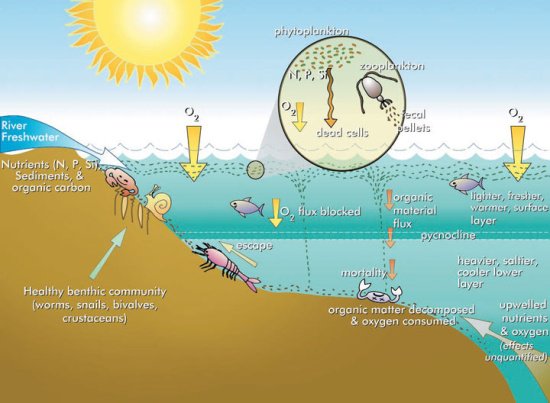

Diagram of hypoxia (or low dissolved oxygen) in coastal waters.

Don’t despair, there is some good news. Oil naturally seeps into the ocean every day. It’s estimated that about 17 million gallons seep into the Gulf, naturally, every year so Mother Nature has devised a plan to break down oil. After the oil spill, millions of microbes started “eating” the oil.

Researchers are still not sure what type of long-term effects the dispersants will have on the environment, especially since they were used at unprecedented amounts and depths. And, it’s unclear if there will be long-term damage to deep ecosystems but, almost six months later, it seems that Mother Nature has a good handle on the situation. The shoreline impacts have been a lot more limited than we all thought, the marshes are cleaning themselves—and regrowing, bird mortality was not as bad as expected (turtle mortality, however, is another story), and most of the impacted fishing areas are now open (yes, the seafood is safe to eat, too!).

But, like most areas in the world, the coasts and waters off Louisiana still could use a little help. And, that’s just what we’ll be doing this week. As you will read in the coming days, the problems in Louisiana are far larger than one person can solve but, like I always remind myself: Together, a lot of little actions can make one big difference.

See you on the Gulf Coast, y’all!!

Tuesday, February 22, 2011

A Primer on Oil Spill Education: 2010's Incident in the Gulf and the Effects on and Current State of the Ecosystem and Seafood

By Paul C. Focazio, Web Content Manager, New York Sea Grant

“In the last few months we have learned a lot more about the oil spill and future plans for Gulf restoration,” says New York Sea Grant Director James Ammerman. Ammerman first discussed the now largest oil spill in history that followed the incident during a September 2010 talk at Stony Brook Southampton and as part of a panel discussion at Stony Brook University in October 2010. Earlier this month, he was the guest speaker at Stony Brook University’s School of Marine and Atmospheric Sciences for an update on the recovery efforts since last spring’s blowout of British Petroleum’s Macondo oil well in the Gulf of Mexico.

“The Oil Spill Commission report has been released and a new restoration task force created." Ammerman is a microbial ecologist interested in nutrient cycling and its contribution to the Gulf's "Dead Zone." From his prior faculty posts at Texas A&M and Rutgers, he led numerous cruises into the Northern Gulf from 2000 to 2004. At Rutgers, he also created and taught courses on the challenges of the Gulf post-Katrina. Released in mid-January 2011, the Report to the U.S. President from National Commission on the BP Oil Spill calls for the federal government to require tougher regulation, stiffer fines and a new industry-run safety organization within the U.S. Interior Department that would be headed by an official with a fixed term of office in order to insulate the appointee from political interference. It also recommends funding the regulatory agency that oversees offshore drilling, the Bureau of Ocean Energy Management, Regulation and Enforcement, with fees from the companies who are exploiting the nation's petroleum resource. The U.S. Interior Department was also advised in the report that it should include the National Oceanic and Atmospheric Administration (NOAA) in the decision-making process about where and how to conduct future oil and gas leasing.

The commission also found the Deepwater Horizon disaster could have been much worse than it was: "At one point, industry experts feared that a significant portion of the 4.6 billion gallon oil and gas reservoir beneath the sea floor could be released into the gulf."

While damaged marshes already appear to be re-growing and bird mortality is less than prior spills, other uncertainties include the impacts on the region’s turtle and tuna populations. Also, seafood appears safe (from open fishing areas in the Gulf), but additional testing is needed.

According to a recent fact sheet produced by Louisiana Sea Grant (LASG), "Seafood Safety in the Wake of the Deepwater Horizon Oil Spill," there is an extensive process to deem if and when to reopen seafood harvesting areas after such an event: "If and once a specific area of water was determined to have an absence of oil, and seafood samples were tested and determined to be free or below levels of concern of polycyclic aromatic or polynuclear hydrocarbons (PAHs), then this area would be opened to fishing."

The National Marine Fisheries Service (NMFS) advises on the safety of harvesting from waters that may have been contaminated by harmful substances; the U.S. Food and Drug Administration (FDA) has authority over the edible portions of seafood and seafood products after harvest; and the Environmental Protection Agency (EPA) has an advisory role regarding the environment from which seafood is harvested, under the Toxic Substances Control Act (TOSCA). State regulations typically mirror the FDA requirements and states often have an MOU (memorandum of understanding) with the FDA to conduct inspections on behalf of the federal agency.

NMFS has published protocols for monitoring seafood, and the FDA has honored this in the event of seafood harvests from oil impacted areas. First, there is a precautionary closure of fishing grounds in the area of the spill. With wave motion, if there is a sheen of oil on the water further away from the spill site, that area and a large safety buffer is closed to all seafood harvesting. FDA maintains and updates tolerance limits for suggested seafood consumption rates based upon identified compounds of concern. These are usually hydrocarbons that may contaminate water, soil, groundwater and aquatic life and contain contaminants of concern (COC) such as aliphatics, aromatics and asphaltics. Most often, these are called PAHs or polycyclic aromatic hydrocarbons (also polynuclear aromatic hydrocarbons). Consumption of PAHs represents the greatest health hazard in seafood contaminated from an oil spill.

The LASG fact sheet, which is produced in conjunction of Louisiana State University's AgCenter, includes answers to a number of other questions and concerns, such as: What are the benefits of consuming Gulf of Mexico seafood? Can seafood really be smelled to detect petrochemical contamination? And, Is there assurance that seafood has been harvested from open waters.

Another way Sea Grant is educating others about the response effort since last April's Gulf oil spill is through a partnership with the New York State Marine Education Association (NYSMEA). Starting today, NYSG staff join teachers from NYSMEA for a five-day trip to south Louisiana to learn about restoration efforts and talk with experts about wildlife rehabilitation.

"Almost five years after my first trip down to New Orleans to help rebuild after Katrina, I’ll be returning to help them recover from another catastrophe," says NYSG's Long Island Sound Educator, Larissa Graham. "This time we’ll be focusing on habitats, the home to wildlife and lifeline for much of New Orleans’ economy."

Monday, February 21, 2011

Sea Grant and NYSMEA Team Up for Hands-on Oil Spill Education and Restoration Efforts

By Paul C. Focazio, Web Content Manager, New York Sea Grant

Starting tomorrow, Tuesday, Feb. 22, New York Sea Grant’s (NYSG) Long Island Sound Educator, Larissa Graham, and Web Content Manager, Paul C. Focazio, will join teachers from the New York State Marine Education Association (NYSMEA) for a five-day trip to south Louisiana to learn about restoration efforts and talk with experts about wildlife rehabilitation. "Though our group is only in Louisiana for a relatively short time, the goal is to learn as much as we can about the various problems affecting the Gulf," says Graham. "This way, when our educators arrive back home, they can better inform others as to how they can help."

As the world is now aware, the 40th anniversary of Earth Day last spring was marred by the blowout of British Petroleum’s Macondo oil well, followed by the largest oil spill in U.S. history. Since then, a number of questions have been posed – Will the Gulf recover from this? Could it happen again? How could we have learned better from past oil spills in our response this time?

“The potential for disaster was great,” says NYSG Director Jim Ammerman of the Gulf oil spill, “But so far environmental impacts have been less than feared.” Ammerman, like many scientists, is quick to remind us that much is still unknown about the oil spill and its impacts and will remain so for some time. “Although shoreline impacts by the spill have been limited, partly due to dispersant use, the ultimate effects of deep water dispersant use are unclear,” says Ammerman. While damaged marshes already appear to be re-growing and bird mortality is less than after prior spills, uncertainties include the impacts on the region’s turtle and tuna populations. Also, seafood appears safe from open fishing areas in the Gulf.

“Oil is not a foreign substance in Gulf waters,” Ammerman said, referring to the area’s natural underwater seeps, from which oil is largely metabolized naturally by bacteria. “The difference, here, though,” he cautioned, “Is that the concentrations of oil from this incident (4.9 million barrels, or 205 million gallons) have been excessive.” So, the long-term effects on fisheries, wetlands and other parts of the ecosystem have yet to be determined.

All the more reason for the NYSMEA educators to pitch-in to do their part and pass on some awareness to others about the status of the Gulf's sprawling ecosystems. "NYSMEA members are eager to assist in restoration efforts, and to raise awareness back in New York that there is plenty of work to be done in the Gulf and here at home," says NYSMEA President Meghan Marrero. "NYSMEA is making a special effort this year to involve our members in stewardship activities. There are many local citizen science activities here in New York, and our annual conference held in June will focus on these and other stewardship opportunities."

Graham, who says she's also looking forward to getting her hands dirty working alongside the educators during the various habitat restoration projects planned in the area, also intends to use the trip as a way of strengthening partnerships with the Louisiana Sea Grant program and the Barataria-Terrebonne National Estuary Program. "After arriving home, I plan to talk to New York Sea Grant staff about ways we can support these programs. And, as part of NYSMEA, I am also hoping to educate fellow NYSMEA members through various presentations at meetings and postings in our newsletter and through social networking."

"Following the trip, we will share what we've learned with other NYSMEA members through a blog and webcasts and at our annual conference," says Marrero. "Several attendees are classroom teachers, and will be bringing what they learned back to their students in the classroom right away."

To that end, NYSG's Focazio will be reporting on the week's activities via this web blog, which will be filled with stories and pictures documenting the educators' experiences. These activities will also include engaging the group in some restoration work, similar to those participated in last fall by Sea Grant staff from the national network’s 32 programs. During their planting, coordinated by Louisiana State University AgCenter Extension Associate Caitlin Reilly, Sea Grant-ers contributed about 55 volunteer hours for a planting effort along 200 feet of shoreline in New Orleans’ City Park. “In the face of land loss, we see a lot of need for restoration in Louisiana, especially after Hurricane Katrina,” says Reilly.

“Between Sea Grant and NYSMEA, we deal with such a wide range of audiences,” Focazio says, “that the blog needs to be user-friendly, interesting and informative.” Target audiences include everyday people, the media, legislators and partners, such as Sea Grant's parent organization, the National Oceanic and Atmospheric Administration. Perhaps the most important use of the blog, though, is for it to serve as a resource for teachers and students. "The ultimate goal here is to have the blog be viewed as an educational tool with a high multiplier effect for learning about coastal restoration and other issues related to last year's oil spill."

These concerns span beyond the Gulf, though, says Graham, Editor of last fall’s oil spill-themed Sound Update newsletter, which focuses on the region around New York/Connecticut's Long Island Sound. “This oil spill certainly makes us wonder if a similar situation could happen here and if it did, how we would respond,” she says. According to one of the Sound Update articles, the Area Contingency Plan for Long Island Sound documents how the Coast Guard will work with federal, state and local governments to prepare for and respond to oil spills.

For more on NOAA Sea Grant's response to the Gulf of Mexico oil spill, see NYSG's related resource site.